Launch Offer
Valid until today,
The Easiest Way to Read an ECG Without Panicking!
The material for student nurses, staff nurses and newly qualified doctors who need to recognise a rhythm, a block or an MI before anyone senior gets to the bedside: explained with pictures, on real tracings.
I WANT TO READ ECGs WITH CONFIDENCESecure checkout · Instant download · 30-day guarantee
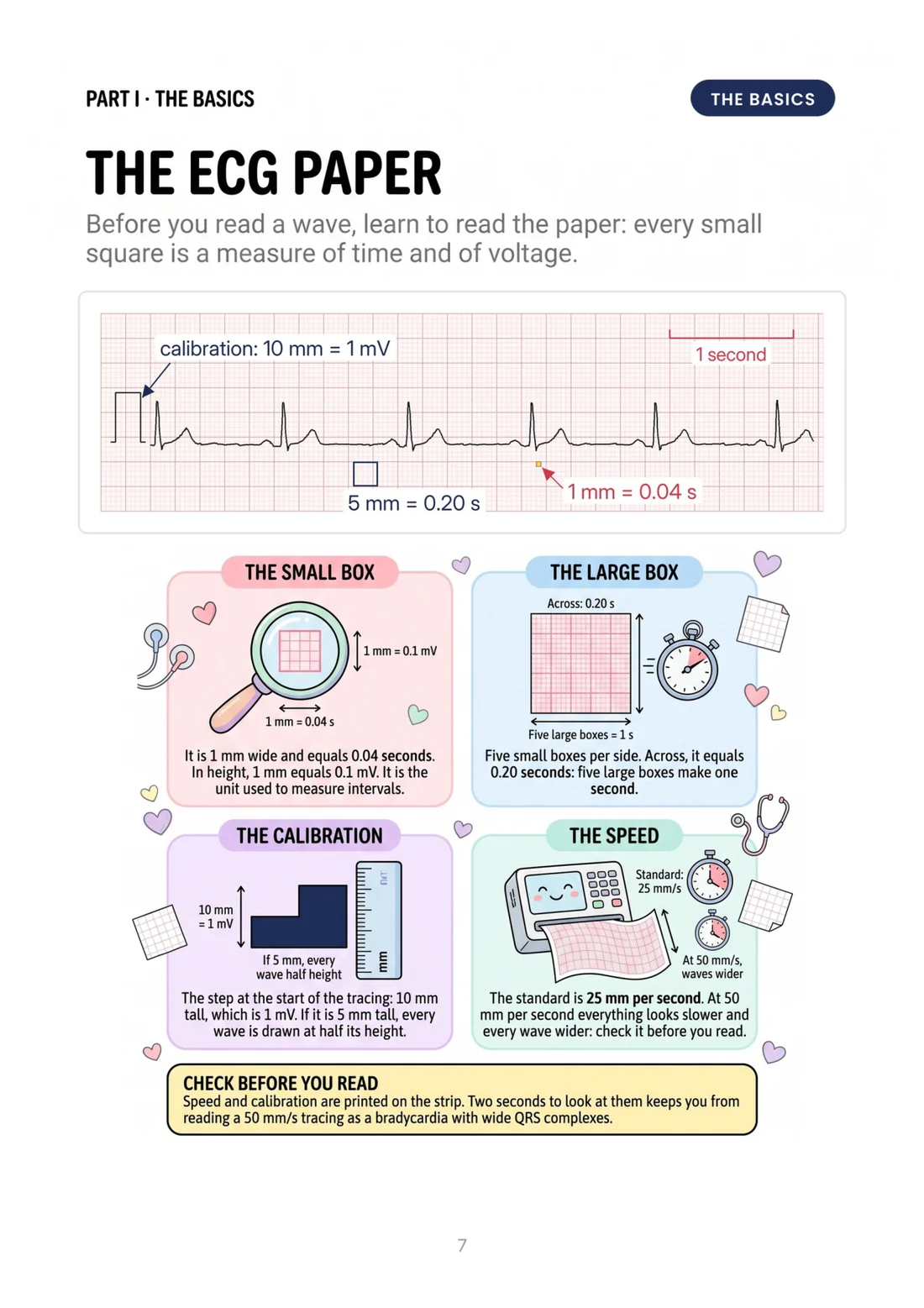
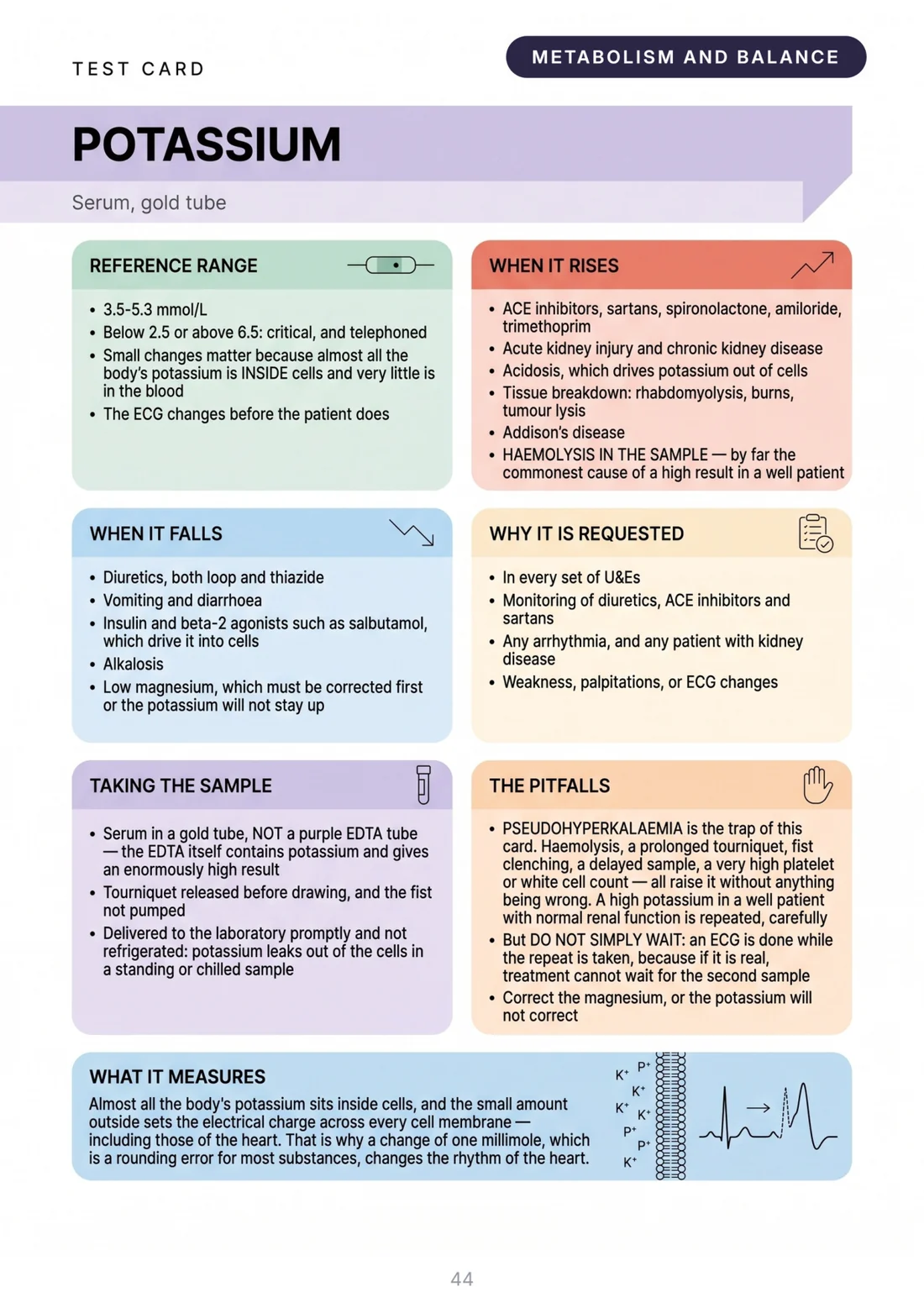
Here's What the Pages You'll Study Look Like
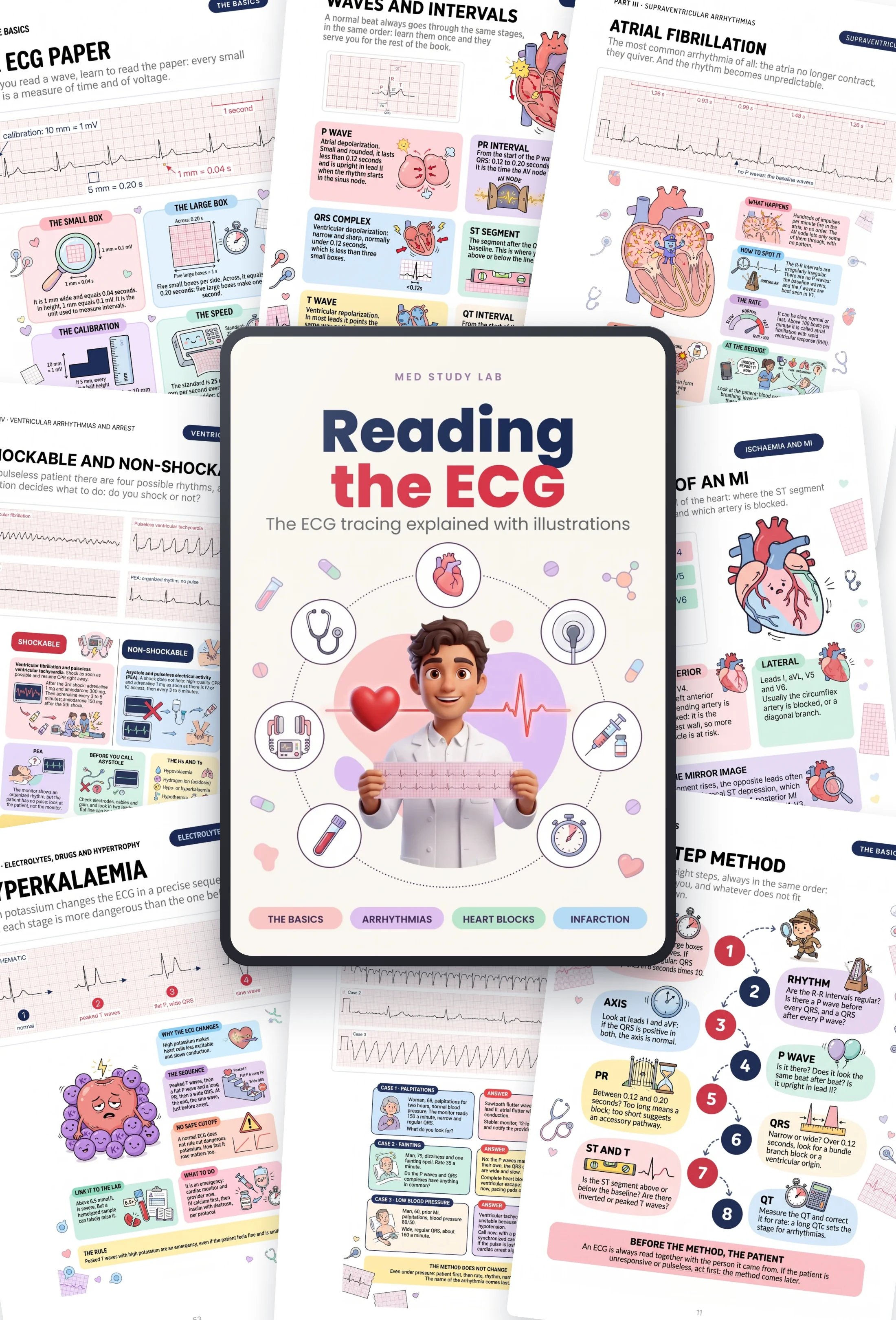
One topic per page, the real tracing in the middle and the drawing that tells you where to look. Look inside:
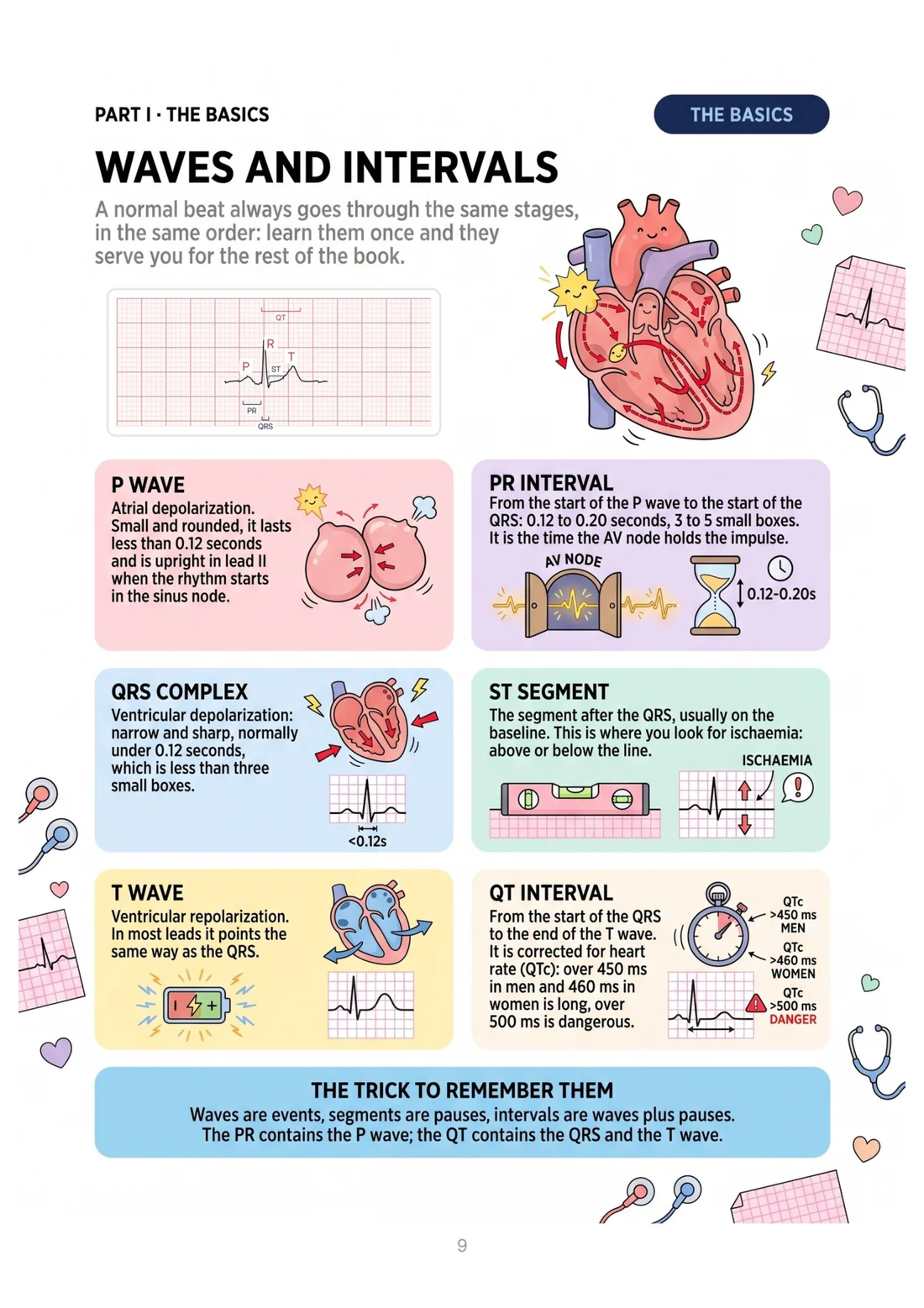
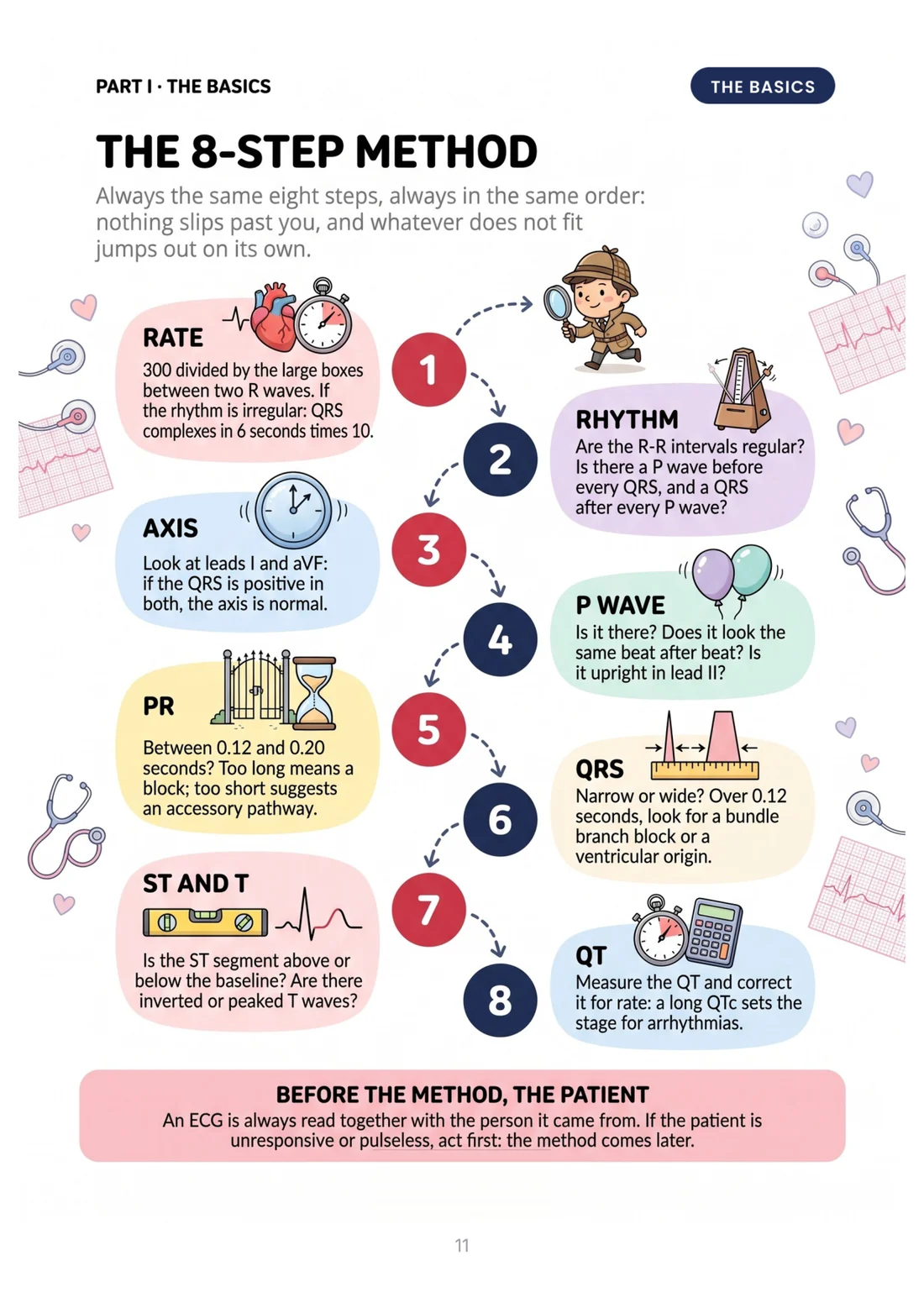
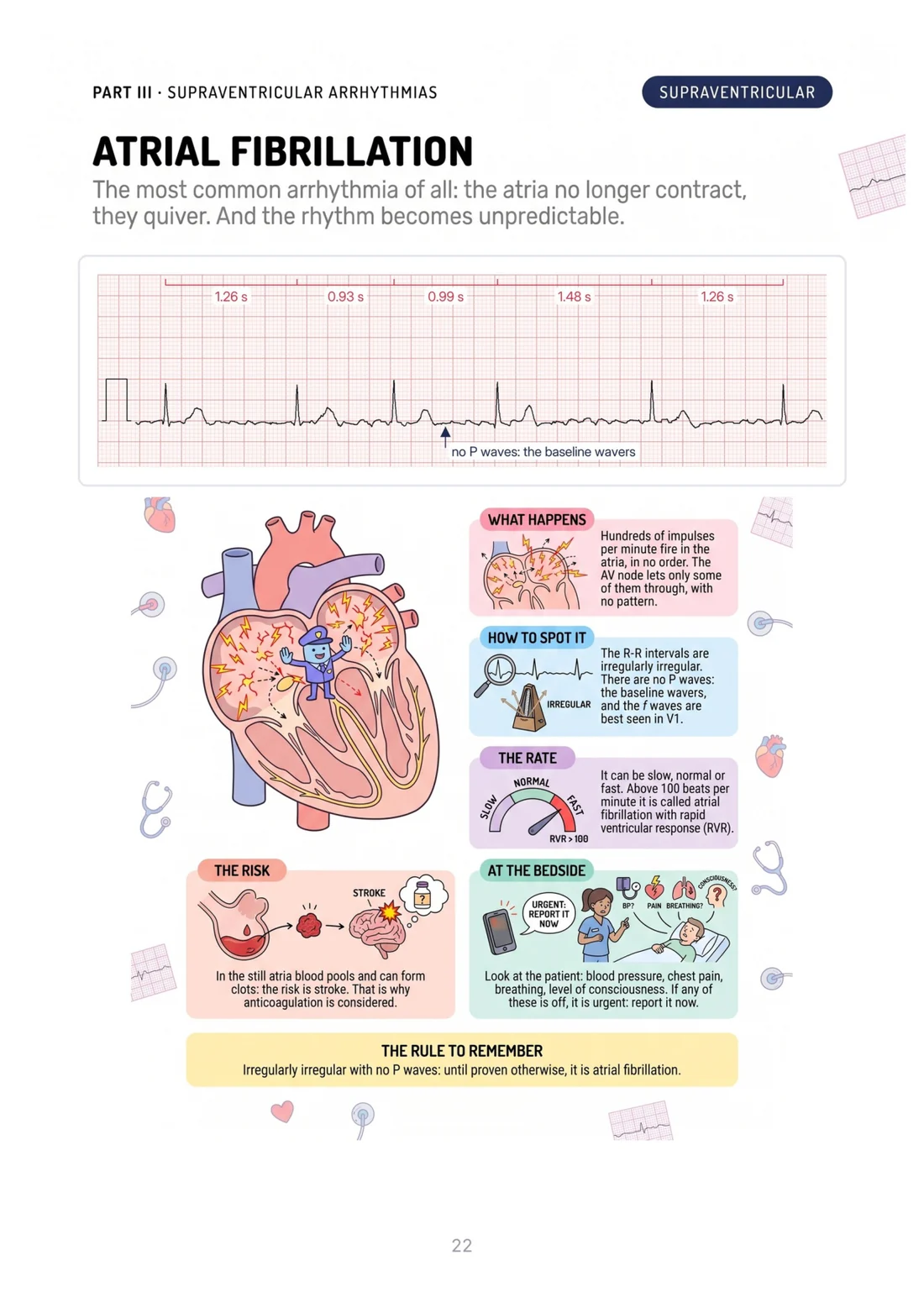
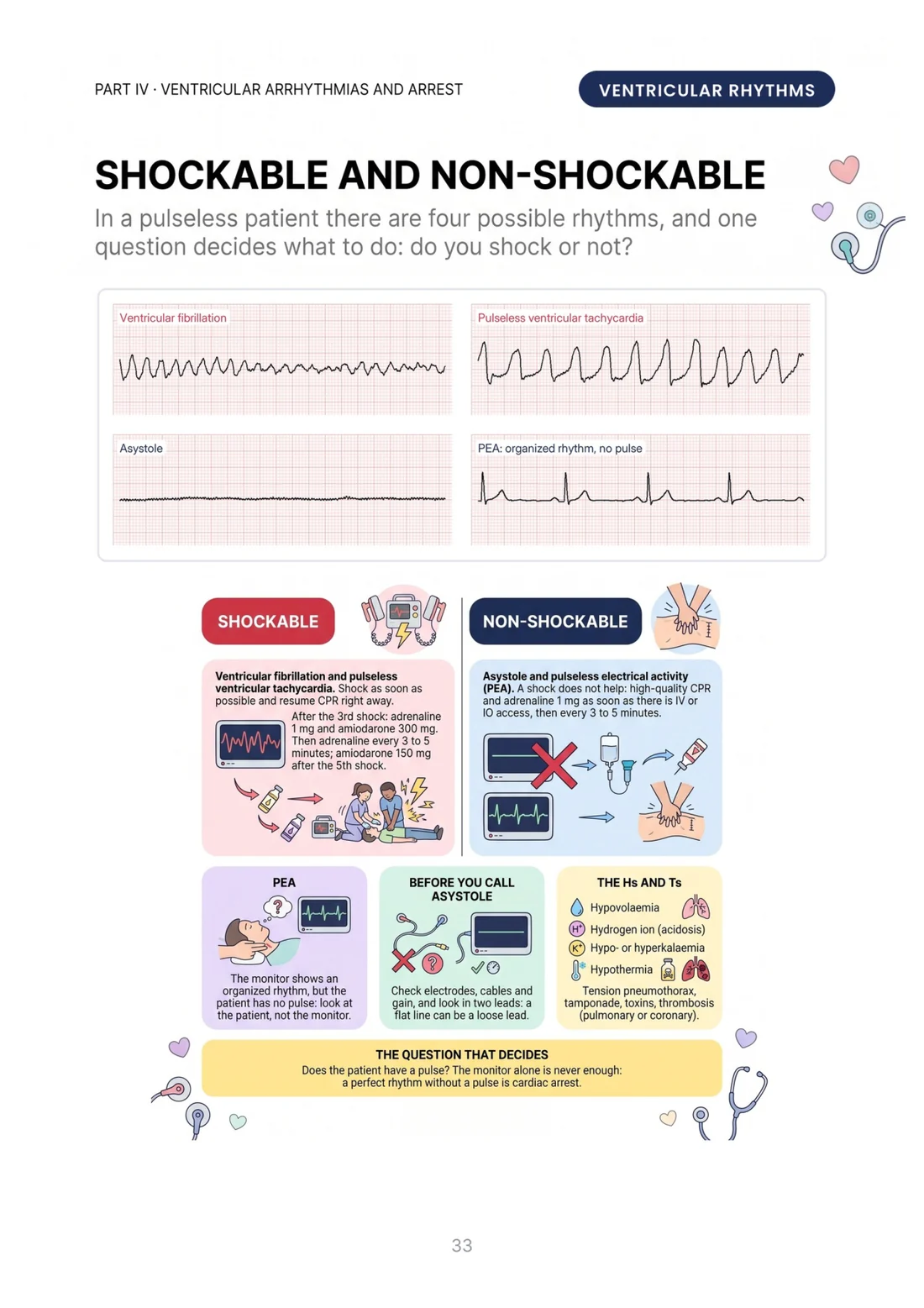
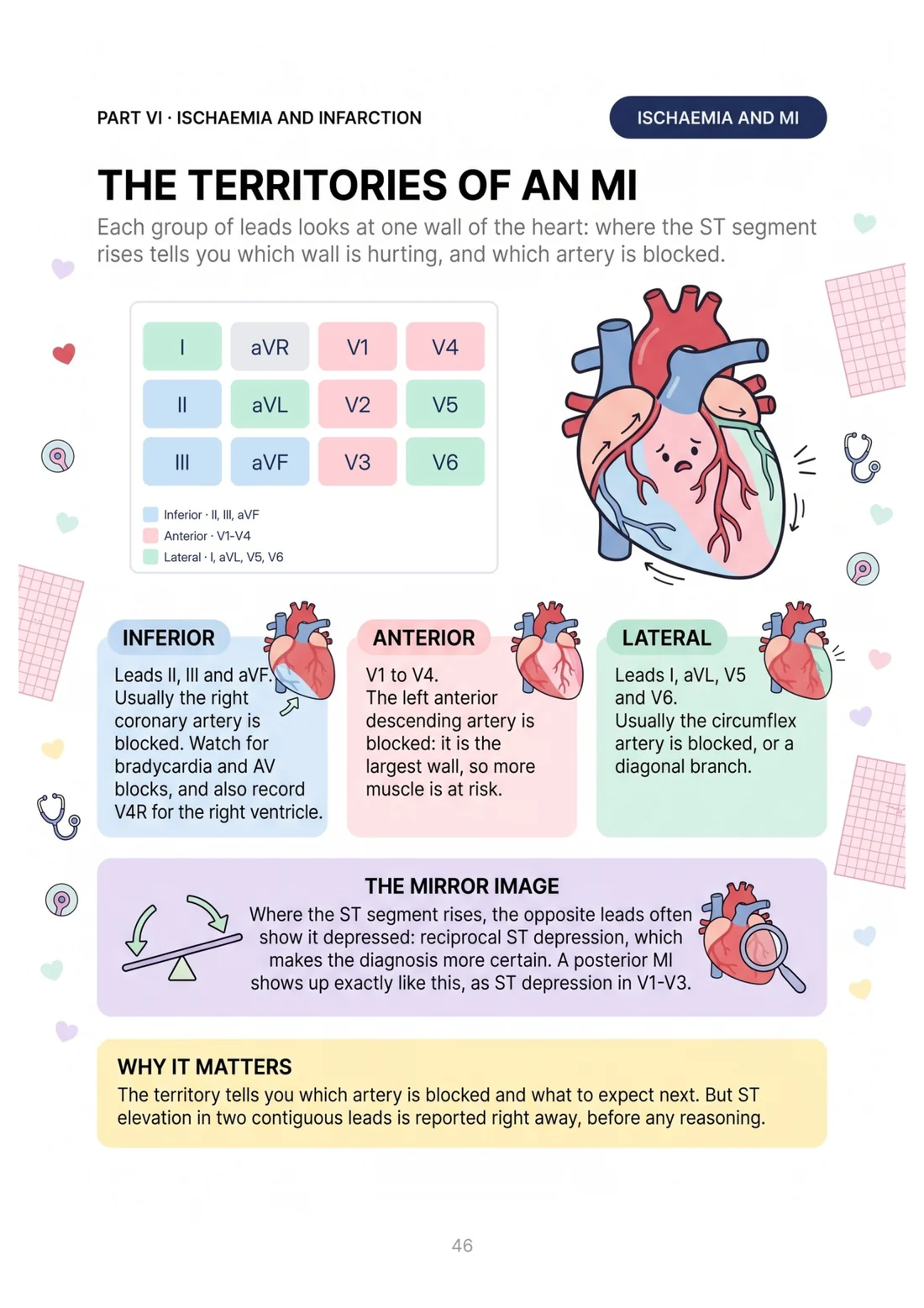
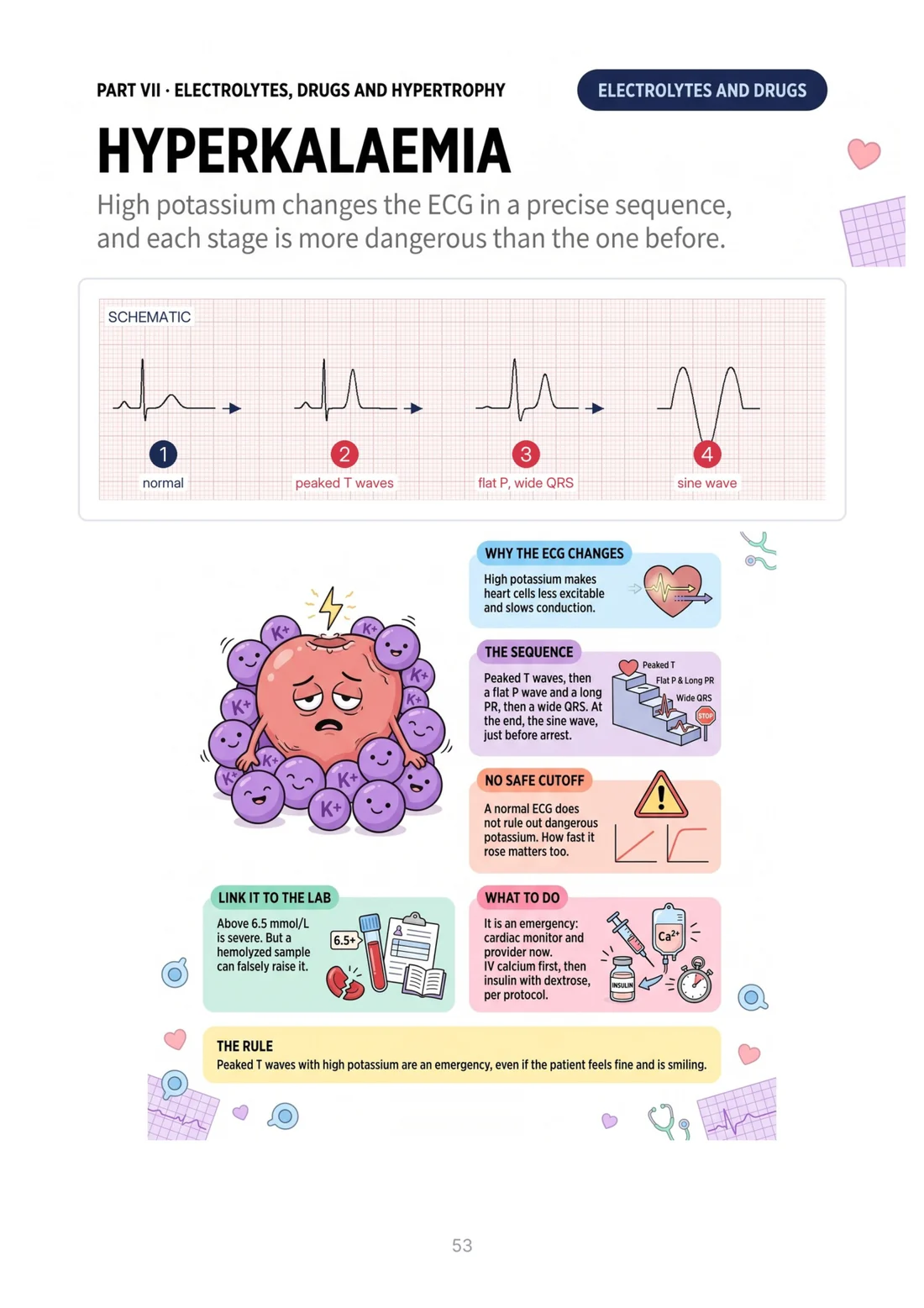
Written for UK practice. Everything inside follows how you practise here: the arrest sequence follows Resuscitation Council UK guidance, the drug is adrenaline, the electrodes use the IEC colours and every blood result is in SI units.
Why the Tracings Are Real, Not Drawn
Almost every textbook shows perfect, hand-drawn waves: clean lines, no noise, every wave in its place.
Then you get on to the ward and the strip in front of you looks nothing like the ones you studied.
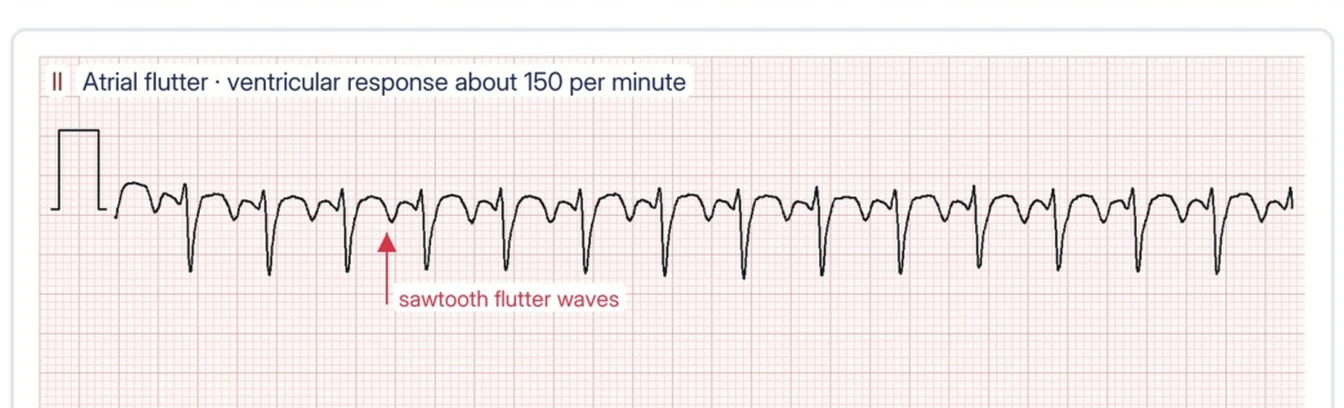
That's why every tracing in the book comes from PTB-XL: a public collection of 21,799 12-lead ECGs from 18,869 patients, each one reported by cardiologists and published on PhysioNet.
They're printed on real ECG paper, at 25 mm per second and 10 mm per millivolt, just as they come out of the machine. The drawing around them tells you where to look; the tracing stays a real patient's.
So your eye trains on what you'll really see.
The Difference Is Visual
Stop staring at a tracing without knowing where to start:
FROM THIS
- Twelve leads and no order
- You don't know where to look
- The doubt comes when there's no time
TO THIS
- A method in eight steps
- The drawing shows you what to look for
- You recognise it at first glance
Table of Contents
Take a Look at the 8 Parts and 51 Chapters
From the ECG paper to infarction, electrolytes and cases at the bedside: 68 pages, all illustrated
- The electrical heart
- The ECG paper
- The 12 leads
- Waves and intervals
- Where the electrodes go
- The 8-step method
- Part review
- Calculating the rate
- Normal sinus rhythm
- Sinus tachycardia and sinus bradycardia
- Sinus arrhythmia
- The axis in two leads
- Part review
- Premature atrial contractions
- Atrial fibrillation
- Atrial flutter
- Supraventricular tachycardia
- Wolff-Parkinson-White
- Part review
- Premature ventricular contractions
- Ventricular tachycardia
- Torsades de pointes
- Ventricular fibrillation
- Asystole and pulseless electrical activity
- Shockable and non-shockable
- Part review
- First-degree AV block
- Second-degree AV block
- Third-degree (complete) AV block
- Right bundle branch block
- Left bundle branch block
- Fascicular blocks
- Part review
- Ischaemia, injury, infarction
- STEMI: the criteria
- The territories: inferior, anterior, lateral
- Posterior and right ventricle
- ST depression and NSTEMI
- Q waves and evolution
- STEMI mimics
- Part review
- Hyperkalaemia
- Hypokalaemia
- Calcium
- Long QT and drugs
- Digoxin
- Ventricular hypertrophy
- Part review
- Artefacts and reversed leads
- When to call right away
- Six guided cases
- Glossary — p. 65
- Sources and references — p. 67
- Index — p. 68
What If There Were an Easier Way?
Imagine this:
Instead of trying to remember fifty different patterns...
...you follow the same eight steps every time, in the same order: rate, rhythm, axis, P wave, PR, QRS, ST segment, QT.
Your brain stops searching at random. Every tracing becomes a checklist, and whatever doesn't fit jumps out on its own.
That's exactly what Reading the ECG does.
It isn't “just another PDF”. It's a method in 8 parts and 51 illustrated chapters, built on real tracings, so you understand what you see instead of memorising pictures.
Because when you know where to look, even the ugliest strip starts to make sense.
Here's What You Get With Reading the ECG:
I
pp. 5–12
The Basics
The paper, the twelve leads and the IEC lead colours: the vocabulary you need to read everything else.
II
pp. 13–19
Rate, Rhythm and Axis
Rate, rhythm and axis: the first three steps, done on every strip.
III
pp. 20–26
Supraventricular Arrhythmias
Atrial fibrillation, flutter and SVT: when the rhythm starts in the atria and races.
IV
pp. 27–34
Ventricular Arrhythmias and Arrest
From ectopics to the arrest rhythms, split into shockable and non-shockable, the Resuscitation Council UK way.
V
pp. 35–42
Heart Blocks
AV blocks and bundle branch blocks: where the impulse slows down or stops.
VI
pp. 43–51
Ischaemia and Infarction
The ST elevation you cannot miss, territory by territory, and what mimics it.
VII
pp. 52–59
Electrolytes, Drugs and Hypertrophy
Potassium, calcium and the drugs that prolong the QT, in mmol/L: the ECG that changes with the bloods.
VIII
pp. 60–64
At the Bedside
Artefacts and reversed leads, when to escalate straight away, and six guided cases.
At the end: a glossary, sources and references and an index to find every topic.
But That's Not All: You Also Get 2 Bonus Books
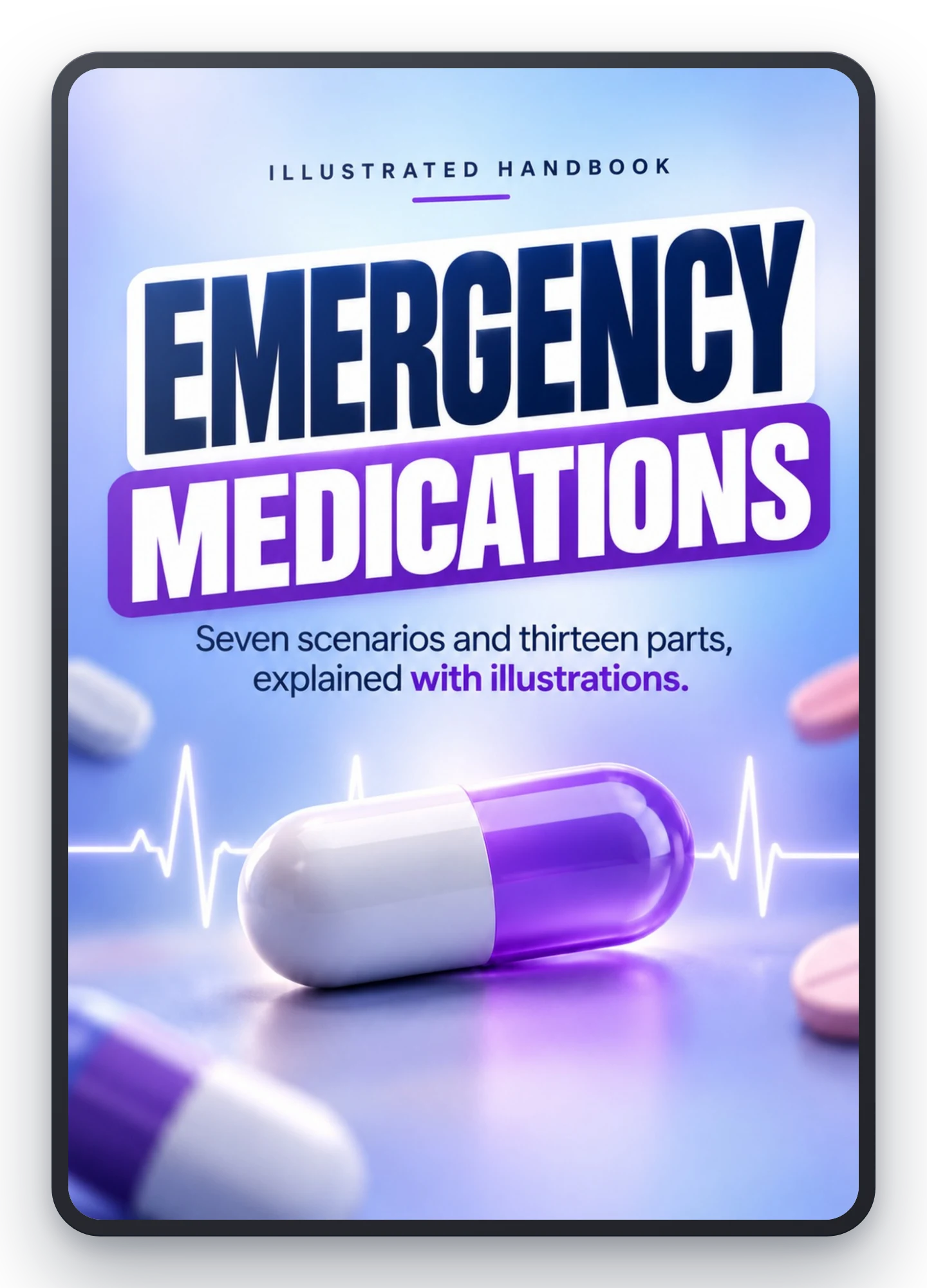
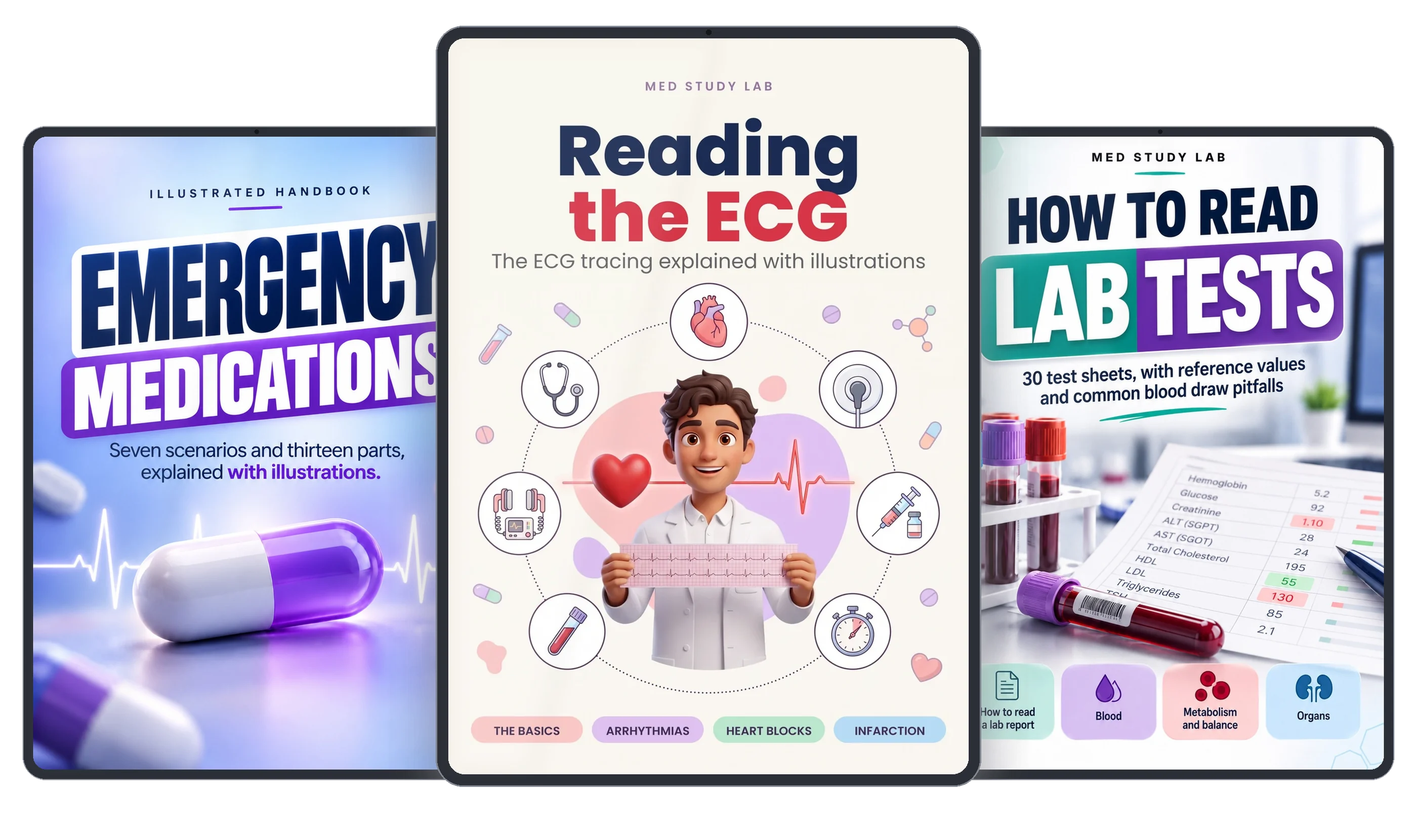
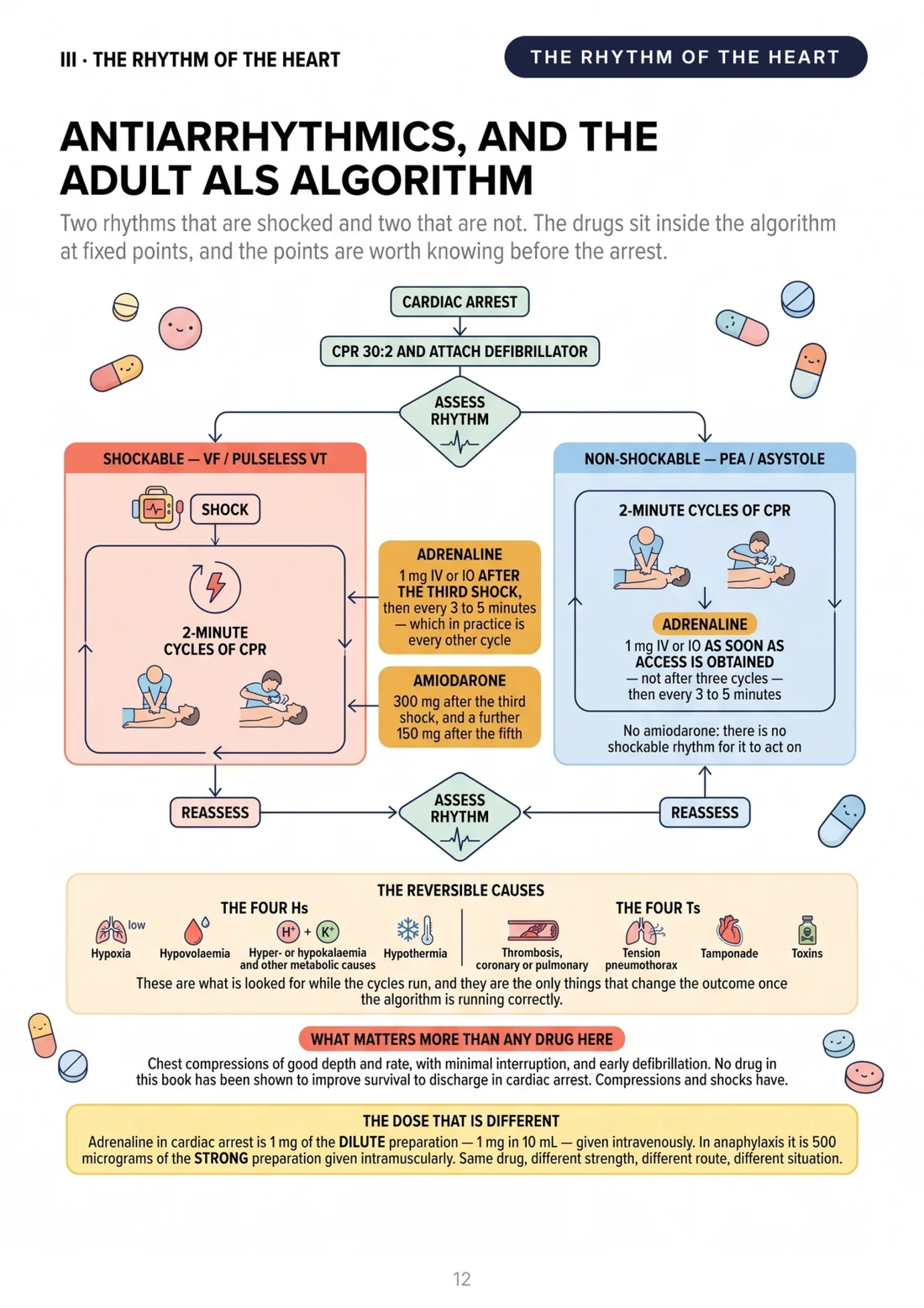
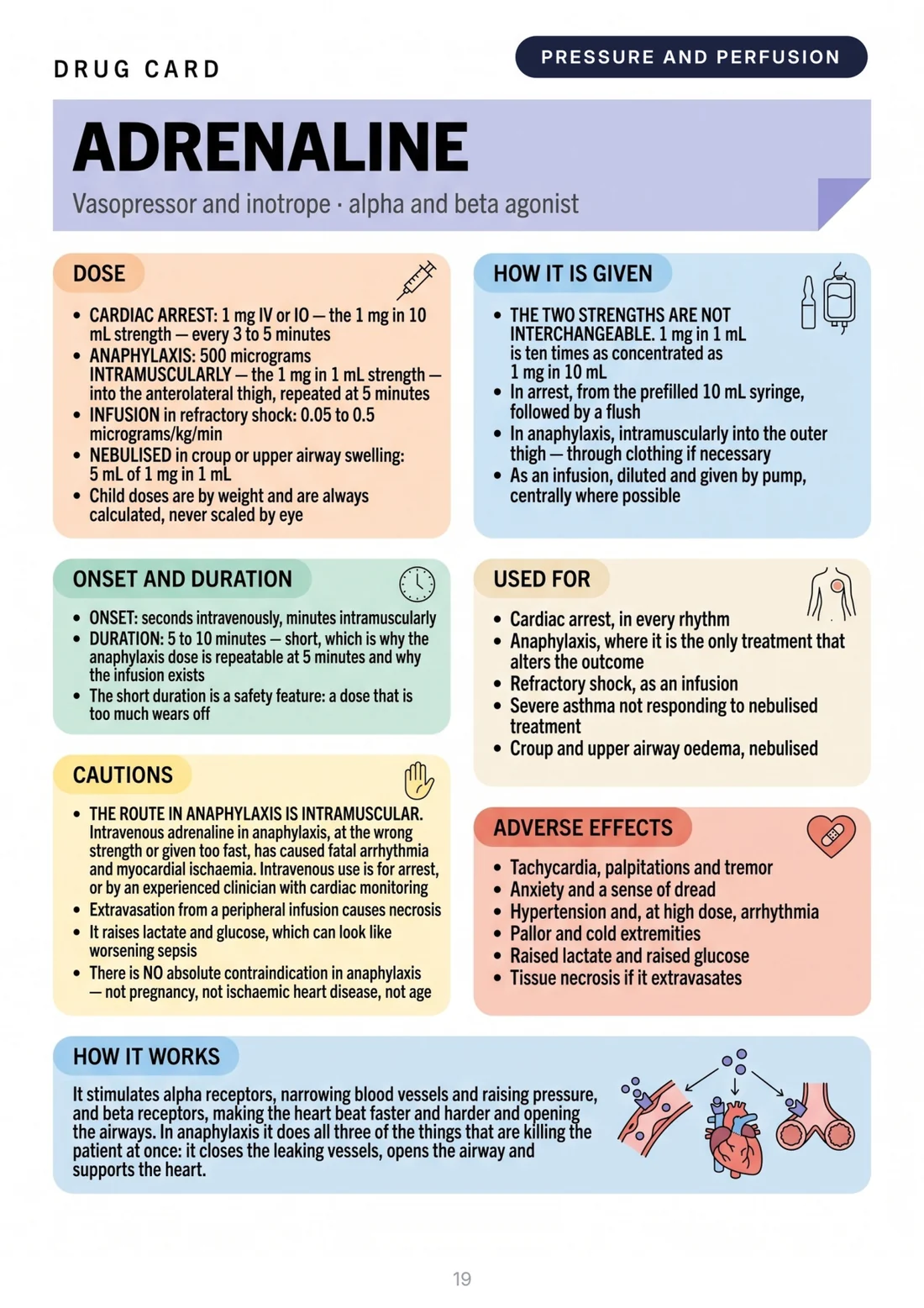
BONUS 1: “Emergency Medications”, the illustrated handbook
Standalone value: £19
82 pages on the drugs you reach for when a tracing becomes an emergency: adenosine, amiodarone, atropine and adrenaline, with the doses, strengths and dilutions worth knowing before the arrest call.
It completes Part IV of the book: you recognise the rhythm, and you already know what gets drawn up. The adult ALS algorithm follows Resuscitation Council UK guidance.
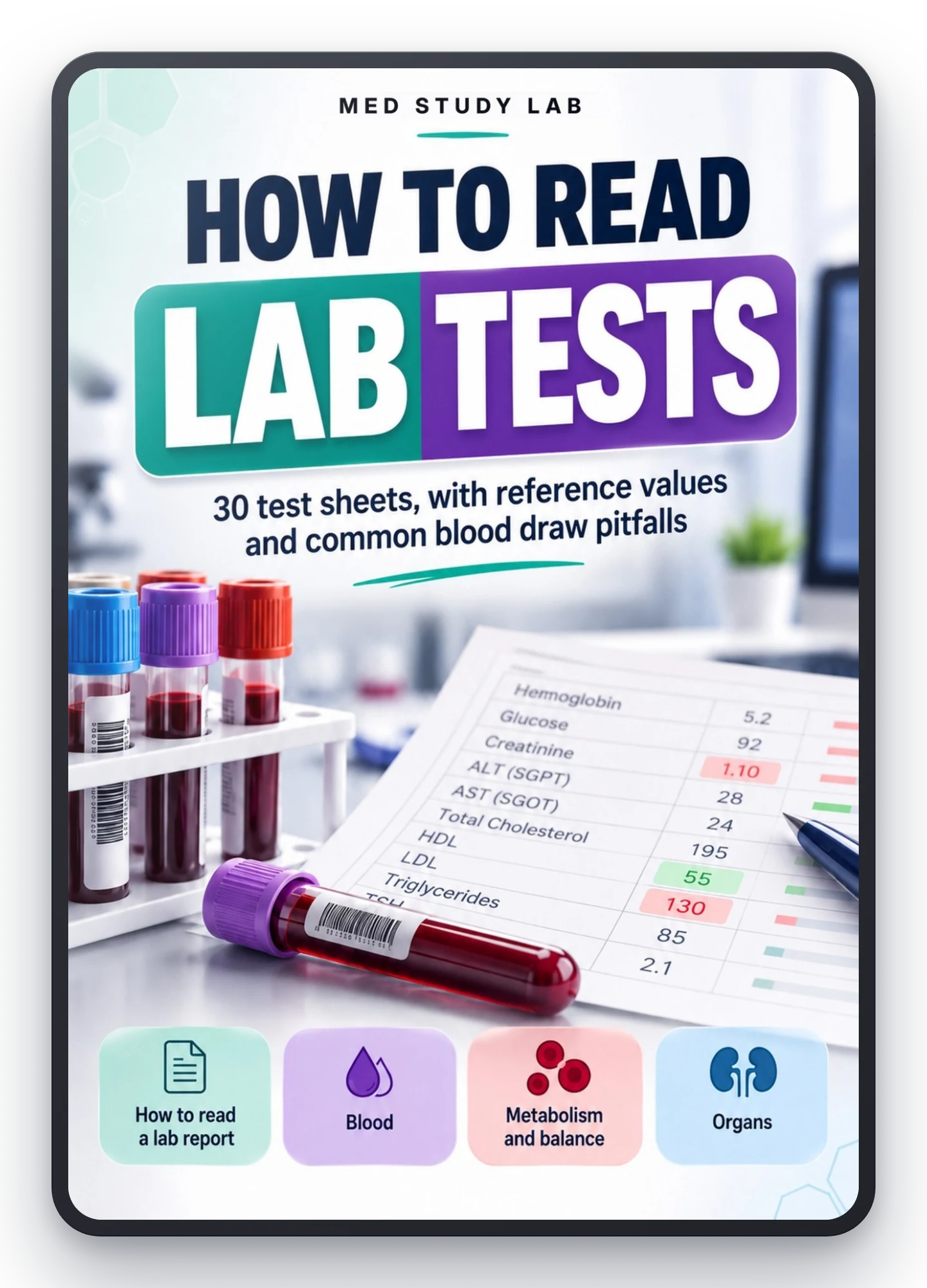
BONUS 2: “How to Read Lab Tests”
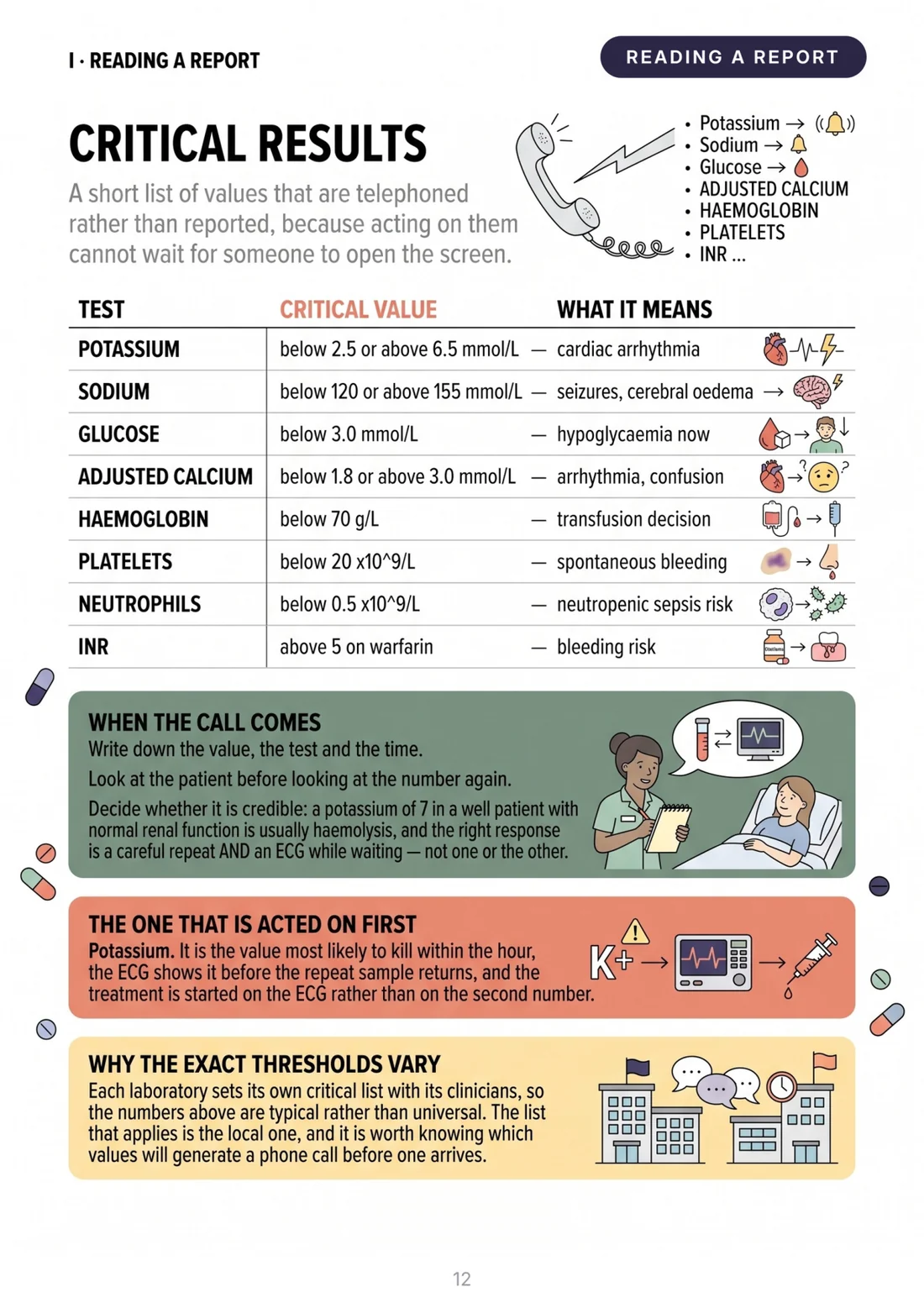
Standalone value: £17
74 pages to read a set of bloods: potassium, adjusted calcium, troponin and the full blood count, in mmol/L and the rest of the SI units, with the critical values that get telephoned and the pitfalls that throw them off.
Read it next to Part VII: a peaked T wave and a potassium of 6.8 are the same emergency seen from two sides.
Reading the ECG + 2 Bonus Books
- Reading the ECG: 68 illustrated pages£55
- Bonus 1: Emergency Medications£19
- Bonus 2: How to Read Lab Tests£17
- High-resolution printable PDFsIncluded
Total value: £91
Today only:
$27
YOU SAVE £71.01
Secure purchase
Encrypted payment
30-day guarantee
All 3 books arrive by email right after purchase. One-off payment, no instalments or hidden fees.
Is This Material Right for You?

Student nurse or medical student
ECGs come up in exams and on placement, and the textbooks explain them as if you already knew. You need to start from the paper and get to infarction without skipping a step.

Staff nurse, HCA or paramedic
The monitor alarms, the tracing changes, and you're the first to see it. You want to know in seconds whether it's an artefact or a reason to escalate straight away.

Newly qualified, or an F1 on nights
On nights or on a busy ward, you often read the ECG on your own. You need a safe method and a quick revision of blocks, ischaemia and electrolytes.
Who's Behind Med Study Lab

To Recap: Here's Everything You Get
- Reading the ECG: 68 illustrated pages in 8 parts, from the ECG paper to infarction and electrolytes, on real tracings
- Written for UK practice: Resuscitation Council UK guidance, adrenaline, IEC lead colours and SI units
- Bonus 1: “Emergency Medications”, illustrated handbook, 82 pages (value £19)
- Bonus 2: “How to Read Lab Tests”, 74 pages (value £17)
- Delivery: all 3 books by email right after purchase
- 30-day guarantee, no questions asked: try it risk-free
- High-resolution PDFs: print them, annotate them, take them on to the ward
£91
$27
“Risk-Free Trial” Guarantee: 30 Days
You have 30 full days to try Reading the ECG and the two bonus books.
If in that time you feel the material didn't help you, wasn't useful or simply wasn't what you expected, I'll refund 100% of your purchase.
No questions. No small print. No hassle.
The risk is ZERO. The decision is yours.
Frequently Asked Questions
Yes. This edition is written for UK practice: Resuscitation Council UK guidance, adrenaline rather than the American name, the IEC lead colours and bloods in SI units.
Right after purchase you get an automatic email with all three books: Reading the ECG and the two bonus books, Emergency Medications and How to Read Lab Tests. They are high-resolution PDFs, ready to download, print or read on any device.
One-off payment of $27. No instalments, no recurring charges, no surprises. You pay once and the material is yours to keep.
No, you start from zero: Part I explains the paper, the leads, where the electrodes go and the IEC colours before any arrhythmia. If you already read ECGs, you get the 8-step method and the chapters on infarction and electrolytes.
Real. They come from PTB-XL, a public collection of 21,799 12-lead ECGs from 18,869 patients, reported by cardiologists and published on PhysioNet. A drawn tracing is always clean; the ones you meet on the ward are not, and those are the ones to train your eye on.
No. It is study material to understand and recognise, not a clinical protocol, and it is not affiliated with or endorsed by the NHS or any trust. With a real patient you follow your trust's policies and escalate when in doubt: the book helps you get there prepared.
Yes, for personal use and without limits. The PDFs are high resolution, made to print, annotate and take on to the ward or to placement.
One Last Thing Before You Decide...
The ECG doesn't have to be the part you avoid.
You don't have to memorise fifty patterns without understanding why they look that way.
And you definitely don't have to find out you can't read one right when it matters.
There's an easier way. And it's one click away.
Eight steps, real tracings and two bonus books for the acute end of the ward.
Now it's your turn.
- One-off payment: $27
- Guarantee: 30 days, no questions asked
- Delivery: all 3 books right after purchase
The books arrive by email within minutes